Your Cart is Empty

Updated October 2026
Short answer: choose a grinder screen by the result you want and the material you actually have. A finer opening generally slows collection and limits larger plant particles. A coarser opening generally collects faster and allows more plant material through. Start with the standard screen, then adjust only if the sift is greener, slower or more prone to clogging than you prefer.
A kief screen looks like a minor part, but it changes the trade-off between collection speed and particle size. The useful question is not “Which screen is best?” It is “Which result am I trying to produce, and what is this batch doing on the screen?”
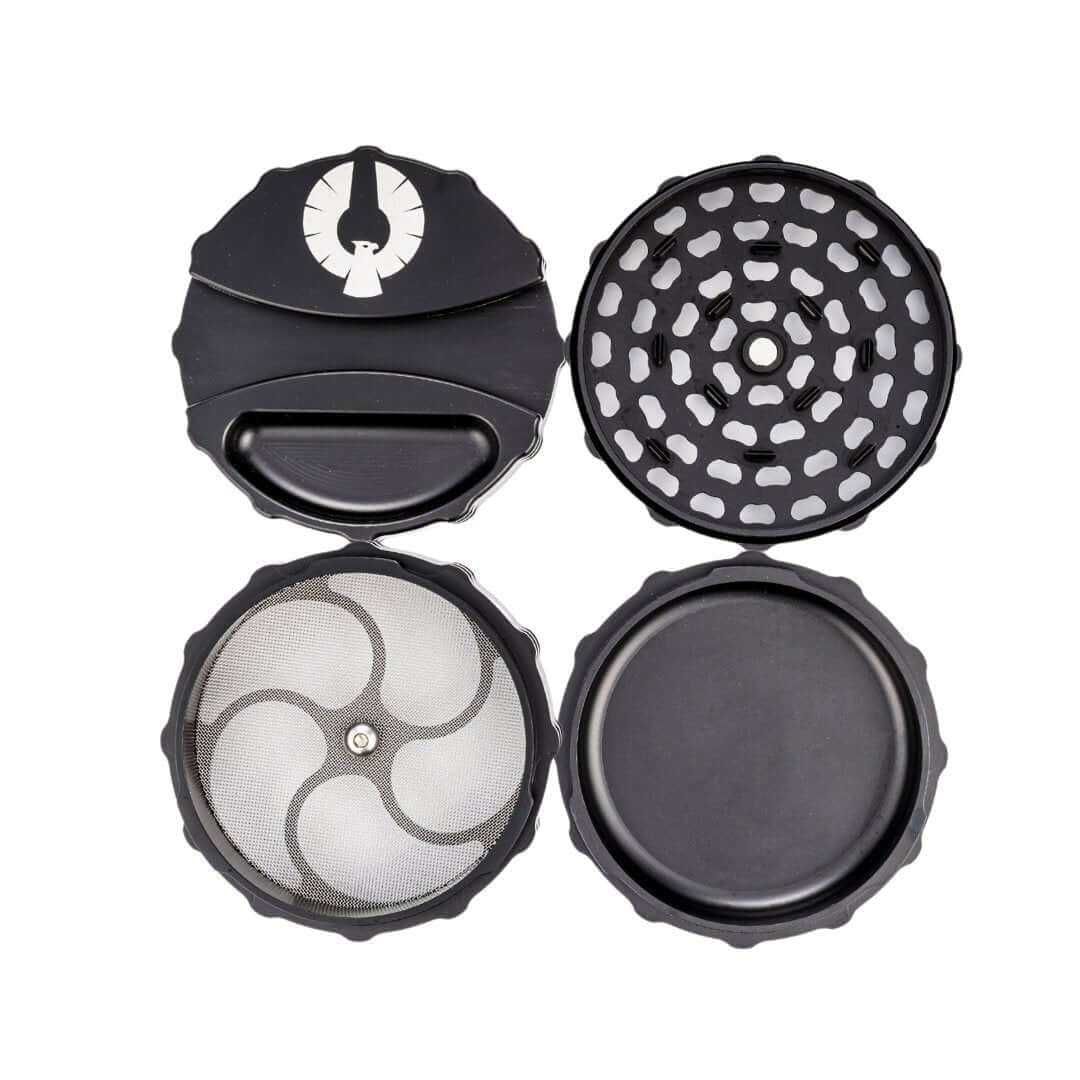
In a 4 piece grinder, ground flower drops out of the teeth and lands on a stainless mesh screen. Every time you twist or tap the grinder, the flower gets jostled, and loose trichomes (the tiny resin glands that frost your buds) shake off and fall through the mesh into the bottom chamber. That golden dust is kief.
The screen has one job: let trichomes through, keep plant matter out. How well it does that depends almost entirely on the size of the holes.
Screen sizes get described two ways, and the internet mixes them up constantly.
So "a fine 80 mesh screen" and "a fine 180 micron screen" are basically the same thing. If a guide tells you a high-micron screen is fine, they've got their units crossed. Here's how the Phoenician screens line up:
| Phoenician screen | Opening | Approx. mesh | Best for |
|---|---|---|---|
| Fine | 180 micron | ~80 mesh | Smaller nominal opening; slower, finer sift |
| Standard (ships installed) | 300 micron | ~50 mesh | Middle starting point |
| Coarse | 400 micron | ~40 mesh | Larger nominal opening; faster, coarser sift |
Published measurements of cannabis trichomes vary by structure, cultivar and method, and a screen's nominal opening does not predict the finished sift by itself. Material moisture, handling, screen cleanliness and how vigorously the grinder is moved also matter. Use the micron number as a repeatable starting point, then judge the actual material in the chamber. For background, see our trichomes explainer.

| What you observe | Try next | Why |
|---|---|---|
| You are using a new setup and want a baseline | Standard 300 | Starts between the available fine and coarse options |
| The sift looks greener or contains more visible plant particles than you want | Fine 180 | A smaller nominal opening limits larger particles, usually with slower collection |
| Very little collects after the screen has been cleaned | Standard 300 or coarse 400 | A larger opening may increase collection speed |
| Sticky material repeatedly bridges a clean fine screen | Standard 300 or coarse 400 | A larger opening may be less prone to immediate bridging |
| You prefer slower collection with fewer larger particles | Fine 180 | Prioritizes separation over speed |
| You prioritize faster collection and accept a coarser result | Coarse 400 | Prioritizes throughput over fine separation |
These are practical starting points, not laboratory guarantees. Change one variable at a time, clean the screen before judging it, and compare the sift you actually get.
Your kief chamber is basically a report card. Read it:
One more thing: a dirty screen behaves like a finer screen than it is, and then like no screen at all. Before you blame the size, clean it. Our grinder cleaning guide covers screen care step by step.
The Phoenician screen sits on a spiral brace and is held by a single center screw, so it's removable instead of glued or pressed in. That's the whole system. Here's the swap:
The swap is simple, but take your time: keep the screw secure, seat the replacement screen flat and tighten only until snug.

| Your Phoenician grinder | Choose this kit size |
|---|---|
| Small 4 piece | Small |
| Medium 4 piece | Medium |
| Large 4 piece | Large |
Size must match. Phoenician replacement screens are made for Phoenician 4 piece grinders and their center-screw-and-brace system. They are not intended for Phoenician 2 piece grinders or other brands. If you are unsure which size you own, measure the grinder across its widest point and compare it with the dimensions on the kit product page before ordering.
| Upgrade Kit | Screen Kit | |
|---|---|---|
| Screens | 3 (one fine, one standard, one coarse) | 6 (two of each) |
| Extras | Screw, Lexon ring, Allen key, pick, bumper rings | Screw and Allen key |
| Best for | First-time screen swappers, figuring out your favorite | People who already know their size and want spares |
Both come in small, medium and large to match your grinder, so check your size before you order. Already know your size? Grab the Screen Kit for spares. If you also want grip and drop protection on their own, see Bumper Rings; everything else lives in grinder accessories.
Totally valid. A 2 piece grinder has no screen or separate kief chamber, which means there is no mesh to maintain. Ground flower and loosened trichomes remain together. If that is the setup you prefer, compare the PRO 2 Piece Medium. If you want a separate kief chamber, choose a 4 piece with a removable screen, such as the PRO 4 Piece Medium.
Start with the standard 300 micron screen. Try the fine 180 if you want slower collection with fewer larger particles, or the coarse 400 if a clean screen collects too slowly and you accept a coarser sift.
Coarser. Microns measure the hole size, so a higher micron number means bigger holes. Mesh count works the opposite way.
There is no useful universal schedule. Clean it when collection slows or residue is visible, and replace it if the mesh becomes torn, stretched or remains obstructed after cleaning.
They're sized for Phoenician 4 piece grinders and their screw-and-brace system. We don't recommend them for other brands.
A fine screen changes where loosened material ends up; it does not make the trichomes disappear. More may remain with the flower while less reaches the kief chamber. Your result also depends on the flower, handling and screen cleanliness.
The right screen is the one that gives you the balance of collection speed and particle size you prefer. Match the kit to your grinder size, change one variable at a time, and let the actual sift—not a universal rule—make the decision.
Compare Phoenician’s sharp cutters with Flower Mill’s milling plates—and see why Phoenician is our pick for preserving trichomes, flavor, and an even smoke.

What you actually get at each weed grinder price tier, from budget plastic and zinc to premium machined aluminum, and where Phoenician's $39.99 to $99.99 lineup fits.
A 2 piece weed grinder is a lid and a bowl, nothing else. No screen to clog, no chamber to empty, and a fluffier grind because the flower stays in the teeth instead of dropping through holes. Phoenician 2 piece grinders use the same arced cutter blades, threadless quick lock and aerospace-grade 6061-T6 aluminum as the PRO 4 piece, with a notched grip groove around the body, and they carry the same limited lifetime warranty.
People who roll or pack right away and do not want to collect kief, people who want the fastest clean possible, and anyone who prefers a lighter grinder. If you want to save trichomes, choose a 4 piece grinder with a kief catcher instead.
Medium: 2.47 inch diameter, 1.14 inch tall, 5 oz. The everyday size. $39.99.
Large: 3.225 inch diameter, 1.14 inch tall, 9 oz. For bigger batches and shared sessions. $49.99. See all large weed grinders.
See all weed grinders or read our best weed grinder buyer's guide to compare 2 piece and 4 piece designs side by side.