Your Cart is Empty

Updated October 2026
Short answer: people have grown cannabis for thousands of years, first mostly as hemp for fiber and seed, with the oldest chemical proof of smoking it dating back about 2,500 years in western China. In the U.S. it went from a crop colonists were told to plant, to federal prohibition in 1937, to Schedule I in 1970, to adult-use legal in 24 states plus D.C. by 2026.
Cannabis has a longer résumé than almost anything in your kitchen. It's been rope, sails, ritual, scandal, a Supreme Court case, a magazine, a ballot measure and a federal tax headache. It's also been the excuse for some genuinely ugly laws, and we're not going to skip those parts.
We're a grinder company, so yes, we're biased toward the history of the plant that keeps us in business. But we fact-checked every date below against museums, federal sources, court records and peer-reviewed research, because the internet is full of "ancient Egyptians invented the bong" nonsense. Roll one up (adults 21+, where it's legal) and let's go era by era.
| When | What happened |
|---|---|
| ~12,000 years ago | Genetic research points to early cannabis domestication in East Asia |
| ~2,700 years ago | Cannabis residue burned on an altar at Tel Arad in ancient Judah |
| ~2,500 years ago | Oldest chemical evidence of cannabis smoking, Jirzankal Cemetery, western China |
| 1619 | Virginia's first General Assembly tells colonists to try growing hemp |
| 1905 | U.S. patent granted for a two-part, pin-lined tobacco grinder |
| 1906 | Pure Food and Drug Act requires cannabis in medicines to be labeled |
| 1911 to 1931 | States start banning cannabis; 29 states have outlawed it by 1931 |
| 1936 | Tell Your Children, later known as Reefer Madness, is released |
| 1937 | Marihuana Tax Act effectively criminalizes cannabis nationwide |
| 1951 and 1956 | Boggs Act and Narcotic Control Act add mandatory minimum sentences |
| 1960s | Counterculture, Timothy Leary, and cannabis goes mainstream with young people |
| 1969 | Leary v. United States strikes down the Marihuana Tax Act |
| 1970 | Controlled Substances Act puts marijuana in Schedule I |
| 1973 | Oregon becomes the first state to decriminalize possession |
| 1974 | High Times publishes its first issue |
| 1996 | California's Prop 215 legalizes medical cannabis |
| 2012 | Colorado and Washington vote to legalize adult use |
| 2018 | Farm Bill takes hemp out of the Controlled Substances Act |
| 2024 to 2026 | Federal rescheduling moves partway; hemp gets redefined |
A 2021 genetic study of 110 cannabis genomes concluded the plant was likely first domesticated in East Asia roughly 12,000 years ago, as Smithsonian Magazine reported. Early on it was a multi-use crop: fiber for cord and cloth, seeds for food. The "get high" chapter came later.
In 2020, researchers analyzing two limestone altars from a shrine at Tel Arad, in what's now Israel, found residue of cannabis on one and frankincense on the other. The shrine dates to the 8th century BCE. Translation: somebody was burning flower in a religious setting nearly three millennia ago.
At the Jirzankal Cemetery in the Pamir Mountains of western China, archaeologists found wooden braziers with burned stones inside. Chemical analysis showed cannabis with higher THC levels than typical wild plants, suggesting people were burning it on purpose during funerals. Smithsonian calls it the earliest physical evidence of cannabis smoking. No papers, no grinder, just hot rocks in a wooden bowl. Respect.
Around the 5th century BCE, the Greek historian Herodotus described Scythian nomads throwing hemp seeds onto red-hot stones inside small tents and howling with delight at the vapor. The Jirzankal find lines up nicely with his story, which is a fun moment of an ancient writer turning out to be right.
In India, cannabis has a long religious and cultural history. Bhang, a drink made from cannabis, is tied to the Hindu god Shiva and is still traditionally shared around festivals like Holi and Maha Shivaratri. The Atharva Veda (roughly 1500 to 1000 BCE) lists bhang among sacred plants, though scholars still debate exactly which plant the ancient text meant. Indigenous and traditional uses like this aren't trivia. They're living practices, and they deserve to be described accurately rather than romanticized.
Here's the part that surprises people. In 1619, Virginia's very first General Assembly passed a set of laws that included this: for hemp, "both English and Indian," the assembly did "require and enjoin all householders of this colony" who had the seed to try growing it the next season. You can read the original 1619 laws at Teaching American History.
Hemp meant rope, sailcloth and canvas, which meant ships, which meant empire. George Washington grew it on all five farms at Mount Vernon for rope, thread, canvas and fishing-net repair, according to Mount Vernon's own records. Field labor on plantations like his was done by enslaved people, a part of the hemp story that tends to get left off the T-shirts.
Was anybody smoking it? There's no good evidence the founders were. This was a fiber crop. If someone tells you Jefferson was passing a joint at the Continental Congress, they're selling something.
Quick detour for our own industry. In 1905, William Henry Wingfield and John Balding were granted U.S. Patent 795,746 for a "case and device for holding and disintegrating tobacco or other substances." Two halves, interlocking sharp pins, a twisting motion. Sound familiar? It's the great-grandparent of the thing on your coffee table. We tell the whole story in the real history of the herb grinder.

In the early 1900s, cannabis extracts were sold openly in American pharmacies. The 1906 Pure Food and Drug Act didn't ban them, it just required products containing cannabis (and other drugs) to say so on the label. Then states started banning it. Massachusetts passed a restriction in 1911, California followed in 1913, and by 1931, 29 states had outlawed cannabis.
This is where the story gets uncomfortable, and it should. After the Mexican Revolution began in 1910, many Mexican families moved north for work, and recreational cannabis use became associated with them. As PBS Frontline's marijuana timeline puts it, the fear and prejudice aimed at Spanish-speaking newcomers became attached to the plant itself. Anti-drug campaigners leaned on the Spanish-derived word "marihuana" to make it sound foreign. California's 1913 ban was pushed by a state pharmacy board member who wrote about South Asian immigrants in openly bigoted terms.
In 1930, Harry J. Anslinger became the first commissioner of the new Federal Bureau of Narcotics, a post he held until 1962. He campaigned hard against cannabis, claiming it caused "insanity, criminality, and death," and his campaign trafficked in racial fear. None of those claims held up. A 1944 report from the New York Academy of Medicine, commissioned by Mayor Fiorello La Guardia, found cannabis use did not lead to violence, insanity or sex crimes. By then, the laws were already on the books.
The most famous artifact of this era started life as Tell Your Children, a 1936 morality film financed by a church group and directed by Louis J. Gasnier. An exploitation producer later bought it, spiced it up and toured it under titles like Reefer Madness. Decades later it became a midnight-movie joke. In 1972, NORML founder Keith Stroup found a print in the Library of Congress archives and screened it on college campuses as a fundraiser. Propaganda turned punchline. It made our list of the best stoner movies for exactly that reason.
Congress passed the Marihuana Tax Act in 1937. It didn't technically ban cannabis. It required registration and a transfer tax, with paperwork designed to be nearly impossible to comply with, which effectively criminalized possession and sale nationwide. In the 1950s, the Boggs Act (1951) and the Narcotic Control Act (1956) piled on mandatory minimum sentences.
By the 1960s, cannabis had jumped from jazz clubs and border towns to college campuses, coffee houses and anti-war rallies. For a lot of young people, lighting up was as much a political statement as a pastime, a way of saying "your rules don't fit us." It showed up in the music, the art and the slang of the decade.
The decade's most famous drug-culture figure was Timothy Leary, a Harvard psychologist who, with Richard Alpert, ran the Harvard Psilocybin Project starting in 1960. Harvard parted ways with both of them in 1963. Leary is best remembered for psychedelics, not weed, but his biggest legal impact was all about cannabis.
On December 22, 1965, customs officers in Laredo, Texas found a small amount of marijuana in Leary's car at the Mexico border. He was convicted under the Marihuana Tax Act and appealed all the way up. On May 19, 1969, in Leary v. United States, the Supreme Court unanimously ruled that the Act's registration requirement forced people to incriminate themselves, violating the Fifth Amendment. The 1937 law was dead. Congress replaced it the very next year with something much bigger.
The Comprehensive Drug Abuse Prevention and Control Act of 1970, which includes the Controlled Substances Act, sorted drugs into five schedules. Marijuana went into Schedule I, the category for drugs with "no currently accepted medical use" and high abuse potential, right next to heroin. It was supposed to be temporary while a commission studied it.
That commission, the Shafer Commission, reported in 1972 and recommended removing criminal penalties for personal possession. President Nixon rejected it. Marijuana stayed in Schedule I for more than five decades.
States didn't wait. In 1973, Oregon became the first state to decriminalize possession of small amounts, replacing jail with a fine. About ten more states followed over the rest of the decade.
Activist Tom Forçade launched High Times in summer 1974. The first issue was meant as a one-off parody of Playboy, swapping weed for, well, the other thing. It sold so well it became a monthly and the bible of cannabis culture for decades, later launching the Cannabis Cup in Amsterdam under editor Steven Hager in the late 1980s. High Times also helped turn "420" into a global holiday, which is a whole story on its own: what 420 actually means.
The 1980s went the other direction. The Anti-Drug Abuse Act of 1986 brought back tough mandatory minimums, and cannabis arrests climbed. The burden didn't fall evenly. In its 2020 report, the ACLU found Black people were 3.64 times more likely than white people to be arrested for marijuana possession, even though both groups use it at similar rates. That's not ancient history. It's the reason many legalization laws now include record expungement and social equity licensing.
The crack in the wall came in 1996, when California voters passed Proposition 215, legalizing medical cannabis with a doctor's recommendation. It was the first state medical cannabis law of the modern era, and dozens of states followed.
In November 2012, Colorado (Amendment 64) and Washington (Initiative 502) became the first states to legalize cannabis for adults. Colorado's recreational stores opened on January 1, 2014, and the modern legal market was off and running, along with a lot of demand for better gear than a plastic grinder from a gas station.
In 2018, the Farm Bill took hemp (cannabis with no more than 0.3% delta-9 THC by dry weight) out of the Controlled Substances Act. That opened the door to CBD, and, through a loophole nobody in Congress seemed to plan for, a flood of intoxicating hemp products like delta-8 and high-THCA flower.
The last two years have been a lot. Here's the short version, current as of October 2026:
Meanwhile, according to Pew Research Center, 24 states and D.C. now allow recreational use. Rules still vary a lot by state and city, so check current local law before you assume anything. For the full breakdown of what changed and what didn't, read our 2026 rescheduling and hemp explainer.
Scythians threw seeds on hot rocks. Colonists retted hemp stalks in ponds. Sixties kids picked seeds out on a record sleeve. Today you've got lab-tested flower that costs real money, and the last thing you want is to mash it into dust. The tool matters more than it ever has.
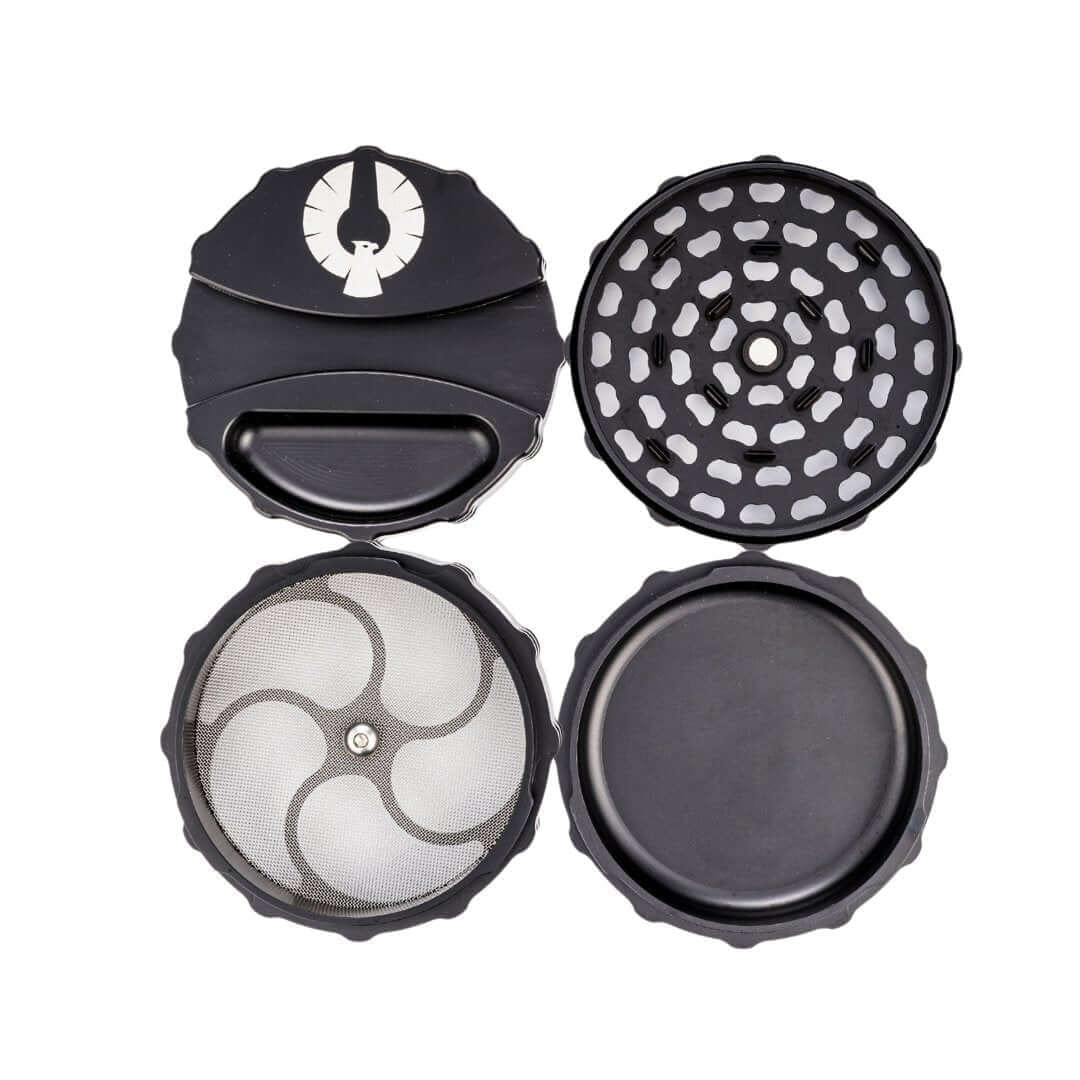
A good grinder cuts instead of crushing, which keeps more trichomes on the flower and gives you an even burn. Load pea-sized pieces around the teeth, give it a few short twists back and forth, tap, done. Want it finer for a vape? Flip it upside down and give it a few extra turns. Our grind guide covers joints, bowls and vapes, and our features page shows why we went threadless: the lock opens with a short twist, about a third of a turn, so there are no threads for resin to gum up.


Want the whole lineup? Browse every Phoenician grinder.
People have cultivated cannabis for thousands of years, with genetic research pointing to domestication in East Asia around 12,000 years ago. The oldest chemical evidence of smoking it is about 2,500 years old, from western China.
States began banning it in the 1910s. The federal Marihuana Tax Act of 1937 effectively criminalized it nationwide, and the Controlled Substances Act placed it in Schedule I in 1970.
Historians point to a mix of racial prejudice against Mexican and other immigrant communities, sensational propaganda like Reefer Madness, and an aggressive federal narcotics bureau. Claims that it caused violence or insanity were later contradicted by research.
Colorado and Washington, by ballot in November 2012. Colorado's adult-use stores opened January 1, 2014.
No. As of October 2026, state-licensed medical marijuana and FDA-approved products are Schedule III, but adult-use marijuana is still Schedule I under federal law. State laws vary, so check yours.
Thousands of years of history, and the best part is you get to write the next sesh. Grind it right.

How to read a cannabis COA in two minutes: verify the lab, calculate total THC from THCA, read terpenes and safety panels, and spot inflated results.

All 50 states plus DC in one table: adult-use, medical and home grow status, plus federal Schedule III, the November 2026 ballot and what to watch in 2027.

The plain-English difference between CBD and THC: the chemistry, how each feels, THCA and delta-8, the late-2026 federal hemp changes, drug tests and how to read a label.
A 2 piece weed grinder is a lid and a bowl, nothing else. No screen to clog, no chamber to empty, and a fluffier grind because the flower stays in the teeth instead of dropping through holes. Phoenician 2 piece grinders use the same arced cutter blades, threadless quick lock and aircraft grade aluminum as the PRO 4 piece, with a notched grip groove around the body, and they carry the same limited lifetime warranty.
People who roll or pack right away and do not want to collect kief, people who want the fastest clean possible, and anyone who prefers a lighter grinder. If you want to save trichomes, choose a 4 piece grinder with a kief catcher instead.
Medium: 2.47 inch diameter, 1.14 inch tall, 5 oz. The everyday size. $39.99.
Large: 3.225 inch diameter, 1.14 inch tall, 9 oz. For bigger batches and shared sessions. $49.99.
See all weed grinders or read the buyer's guide to compare 2 piece and 4 piece designs side by side.