Your Cart is Empty

Updated October 2026
Short answer: a cannabis COA (certificate of analysis) is a lab report for one specific batch. To read it, match the batch number to your package, confirm the lab is licensed and ISO/IEC 17025 accredited, find total THC (THC + THCA x 0.877), skim the terpenes, then make sure every safety test (pesticides, heavy metals, microbials, mycotoxins, solvents, water activity) says Pass.
That little QR code on your jar is the most underrated thing in the dispensary. Most people never scan it. The ones who do usually stare at a PDF full of acronyms, see a big THC number, and close it.
That's a shame, because a COA tells you more about your flower than any budtender pitch or strain name. We're a grinder company, so we care about what happens after the jar opens, and it all starts with what's actually in the jar. Here's how to read one in about two minutes, no chemistry degree required. (Adults 21+, buying from licensed shops where it's legal. Rules vary by state, so check yours.)
A certificate of analysis is a report from a testing lab showing what was found in a sample from one production batch. In licensed state markets, flower usually has to pass testing before it can be sold. California, for example, requires labs to test each batch for cannabinoids, foreign material, heavy metals, microbial impurities, mycotoxins, moisture content and water activity, residual pesticides, residual solvents and, when the label makes terpene claims, terpenoids, according to California's testing regulations.
What a COA isn't: a review, a guarantee about how a strain will feel, or proof about a different batch. It describes one sample from one batch on one date. That's it.
This is where most people get confused, so let's slow down.
Raw cannabis flower contains very little THC. It's mostly THCA, the acid form. When you heat it (lighting a joint, a bowl, a vape), THCA loses part of its molecule and converts to THC. That conversion is called decarboxylation.
Because THCA is heavier than THC, labs don't just add the two together. They use a conversion factor:
Total THC = THC + (THCA x 0.877)
The 0.877 accounts for the weight lost when THCA becomes THC, as the University of Georgia Extension explains. Here's what that looks like on a real-world style report:
| Line on COA | Value |
|---|---|
| THCA | 25.0% |
| Delta-9 THC | 0.5% |
| Total THC (0.5 + 25.0 x 0.877) | 22.4% |
| CBDA / CBD | ND |
| CBGA | 0.9% |
So that "25% THCA" jar is really about 22.4% total THC. Not a scam, just math. Also note:
This formula just became a big deal for hemp. For years, federal hemp rules only counted delta-9 THC, which is how high-THCA "hemp flower" ended up in gas stations. A November 2025 federal law redefined hemp to count total THC, including THCA, at no more than 0.3% on a dry-weight basis, and capped finished hemp products at 0.4 mg total THC per container. After a delay Congress passed in September 2026, most of that takes effect December 11, 2026, according to Foley Hoag.
Run the math: hemp flower with 18% THCA has about 15.8% total THC. That's more than 50 times the new limit. If you've been buying THCA flower, or you sell it, the potency section of the COA is now the whole ballgame. Our 2026 rescheduling and hemp explainer has the full timeline.
Terpenes are the aromatic compounds behind the smell and flavor of your flower: myrcene, limonene, beta-caryophyllene, pinene, linalool and friends. On a COA you'll usually see each terpene listed as a % or mg/g, plus a total.
Terpenes are volatile, which means they evaporate. Heat, light, air and rough handling all chip away at them after testing. More on that below. Our terpene guide goes deep on the common ones.
This is the part people skip, and it's the part that matters most. Every line should read Pass (or ND, or below the action limit).
| Panel | What it checks | What you want to see |
|---|---|---|
| Pesticides | Dozens of residual pesticides, many banned outright | Pass, mostly ND |
| Heavy metals | Arsenic, cadmium, lead, mercury (the plant pulls metals from soil) | Pass, values below limits |
| Microbials | E. coli, Salmonella, and for inhalables, Aspergillus mold species | Not detected / Pass |
| Mycotoxins | Toxins from mold, like aflatoxins and ochratoxin A | Pass |
| Residual solvents | Leftover butane, propane, ethanol and other processing chemicals | Pass (mainly matters for extracts and infused pre-rolls) |
| Foreign material | Hair, insects, sand, debris | Pass |
| Moisture and water activity | How much free water is in the flower | Pass |
If you're reading a COA for a concentrate or vape, the solvent panel deserves a closer look. Hydrocarbon extraction (butane, propane) and ethanol extraction both rely on solvents that get purged afterward, and the test confirms they were. Supercritical CO2 extraction uses carbon dioxide under pressure instead. Solventless products like rosin use only heat and pressure, so there's nothing to purge, though they still get tested for everything else. Whatever the method, the COA is how you know the purge was done right.
Water activity (aw) measures free water available for mold and microbes to use, on a scale from 0 to 1. It's different from moisture content, which is just the percentage of weight that's water. In California, dried flower and pre-rolls pass only if water activity doesn't exceed 0.65.
How to use it: very low numbers can mean over-dried, crumbly flower that burns hot and fast. Numbers right up near the limit suggest flower that was packaged on the wetter side. Somewhere comfortably in the middle usually means a proper dry and cure. If you grow your own, our home grow guide covers drying and curing.
Here's the uncomfortable truth about COAs: the number on the label isn't always the number in the jar.
A 2023 peer-reviewed study in PLOS ONE retested 23 flower samples from 10 Colorado dispensaries. About 70% tested more than 15% below the THC on the label, and on average actual potency was 23.1% lower than the lowest labeled value. The authors pointed to "lab shopping," where growers and brands seek out labs that tend to report higher numbers, and noted a suspicious cluster of results just above 20% THC in some markets. Small study, but it matches what a lot of people in the industry say quietly.
Watch for these:
You did the homework. You found a fresh, well-cured batch with a clean safety panel and a terpene profile you like. Now don't blow it in the last step.
Most of what you just paid for lives in the trichomes, the tiny resin glands on the outside of the flower. Dull grinder teeth and endless spinning mash flower into dust, smear resin on the teeth and knock trichomes loose before they ever reach your bowl. Here's how to keep more of it:


COA stands for certificate of analysis. It's a lab report showing the cannabinoid content, terpenes and safety test results for one batch of product.
Multiply THCA by 0.877 and add any delta-9 THC. For example, 20% THCA plus 0.4% THC equals about 17.9% total THC.
Match the batch number to your package, confirm the lab is state-licensed and ISO/IEC 17025 accredited, and pull the report from the lab's own portal when possible. Make sure safety panels are included, not just potency.
No. Potency numbers can be inflated, and THC alone doesn't describe the aroma, flavor or overall experience. Freshness, cure and terpene content matter too.
In California, flower must test at or below 0.65 water activity to pass. Very low readings can mean over-dried flower, while readings near the limit mean it was packaged on the wetter side.
Read the label, trust the lab (after you verify it), and then treat that flower right.

A fact-checked timeline of cannabis history, from ancient hemp and the first evidence of smoking to Reefer Madness, Schedule I, Prop 215 and 2026 rescheduling.

All 50 states plus DC in one table: adult-use, medical and home grow status, plus federal Schedule III, the November 2026 ballot and what to watch in 2027.

The plain-English difference between CBD and THC: the chemistry, how each feels, THCA and delta-8, the late-2026 federal hemp changes, drug tests and how to read a label.
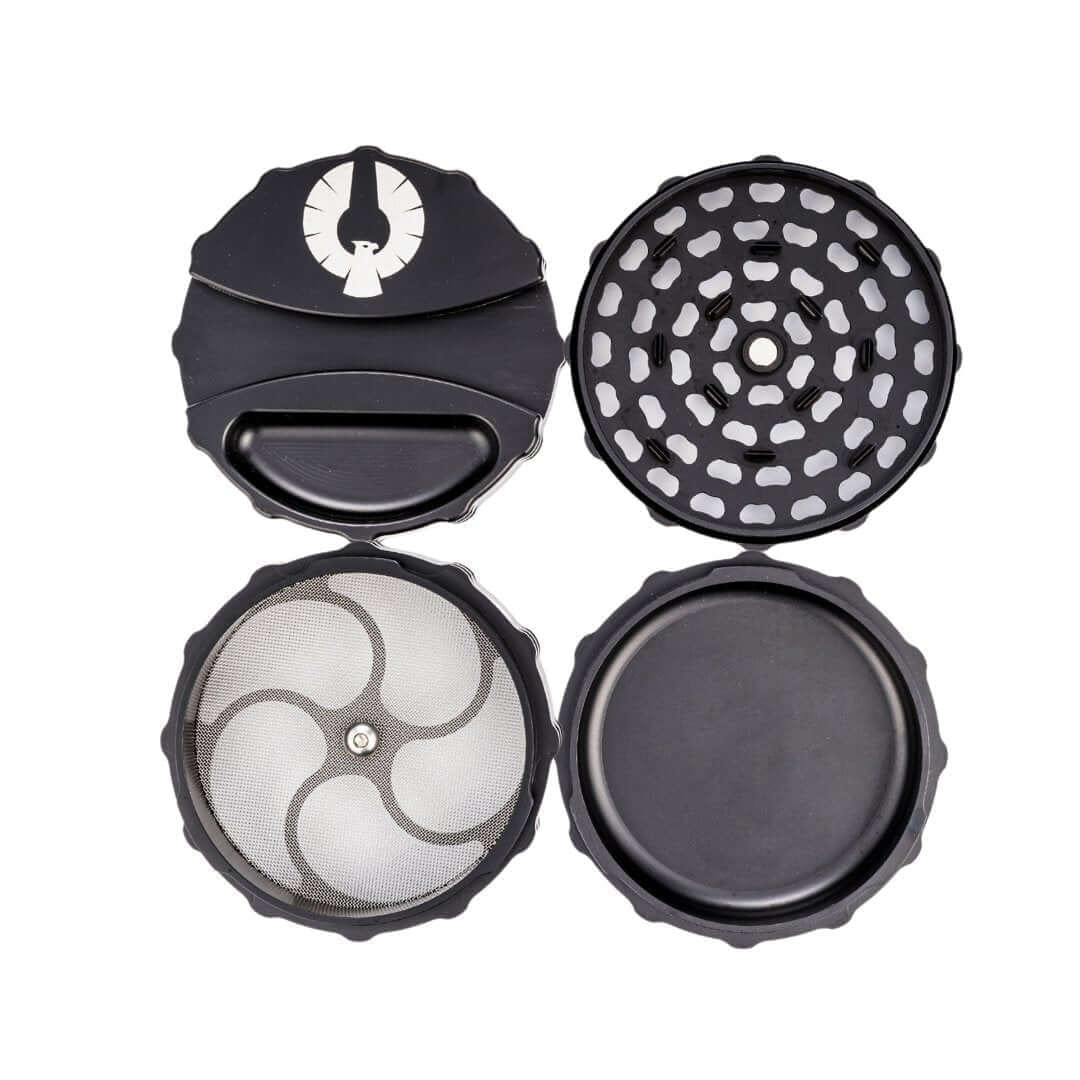
A 2 piece weed grinder is a lid and a bowl, nothing else. No screen to clog, no chamber to empty, and a fluffier grind because the flower stays in the teeth instead of dropping through holes. Phoenician 2 piece grinders use the same arced cutter blades, threadless quick lock and aircraft grade aluminum as the PRO 4 piece, with a notched grip groove around the body, and they carry the same limited lifetime warranty.
People who roll or pack right away and do not want to collect kief, people who want the fastest clean possible, and anyone who prefers a lighter grinder. If you want to save trichomes, choose a 4 piece grinder with a kief catcher instead.
Medium: 2.47 inch diameter, 1.14 inch tall, 5 oz. The everyday size. $39.99.
Large: 3.225 inch diameter, 1.14 inch tall, 9 oz. For bigger batches and shared sessions. $49.99.
See all weed grinders or read the buyer's guide to compare 2 piece and 4 piece designs side by side.