Your Cart is Empty

Short answer: a 4 piece grinder places a screen above a lower chamber, allowing some loose material to sift below the ground flower. Start with the standard screen, tap the closed grinder gently into your palm, and judge the actual collection speed and particle size before changing screens. Use a small scoop over a clean surface, and store collected material securely where cannabis is legal.
That golden dust collecting at the bottom of your grinder is one of the best perks of owning a good 4 piece. A lot of people let it pile up for months without really knowing how it got there or how to get more of it. Here's how kief collection works, how to get more of it without making a mess, and what people actually do with it.

Kief is largely made of loose glandular trichomes. These structures produce and store cannabinoids and terpenes; a peer-reviewed plant-science review explains the biology in detail. When flower is handled or ground, some trichomes and other small particles detach. In a 4 piece grinder, material small enough to pass through the screen can collect in the bottom chamber.
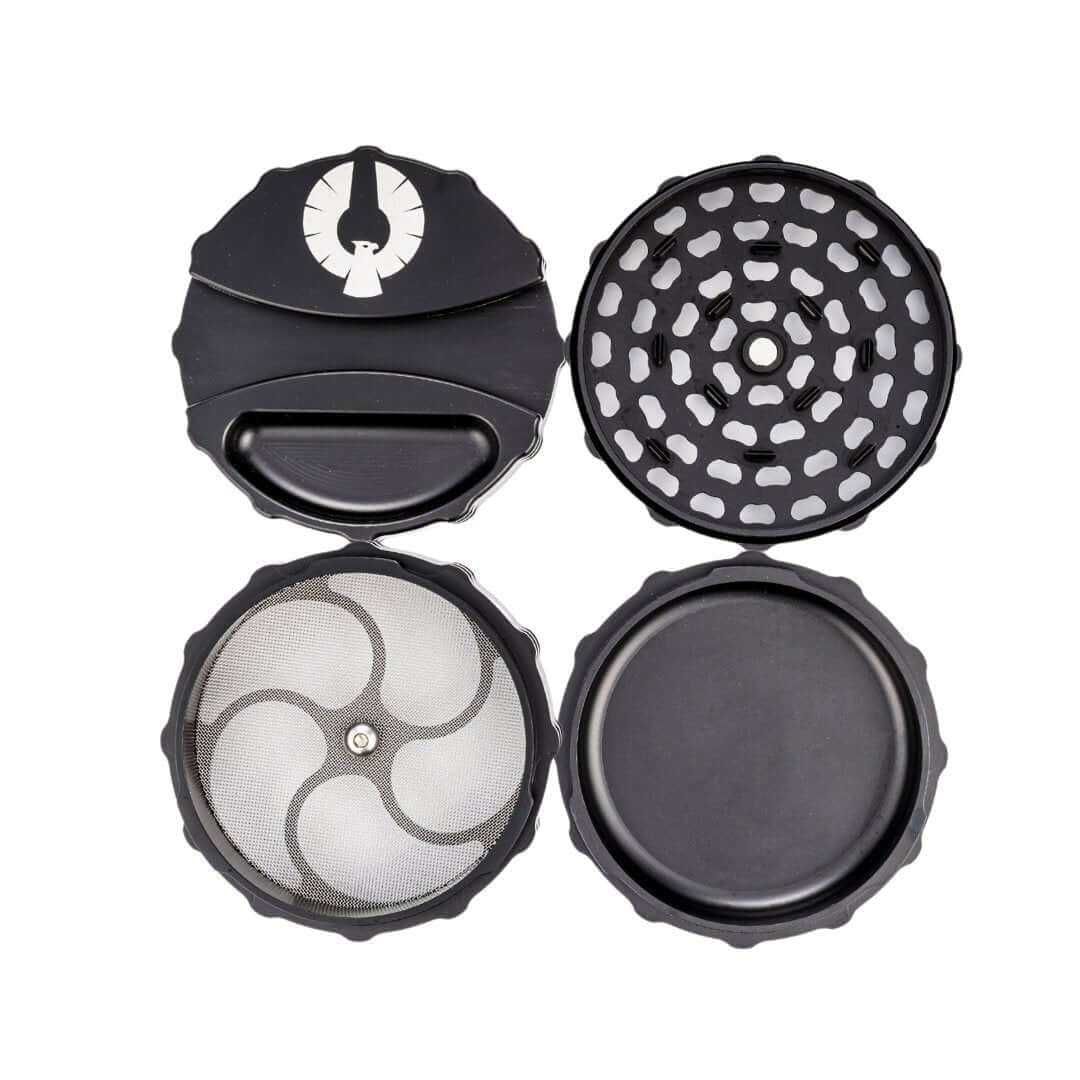
A 4 piece grinder stacks four parts:
Every turn and gentle tap moves ground flower across the screen. Smaller particles can pass through while larger particles remain above. Screen opening, material, handling and cleanliness all affect what collects below.
On a Phoenician 4 piece grinder, the screen is thick stainless steel on a spiral brace held by one center screw, so you can take it out, clean it and swap sizes. The bottom chamber is beveled so kief slides toward the edge for easier scooping, and a kief spoon comes in the box.
Screen opening is one variable among several. Larger nominal openings generally collect faster and may allow more plant particles through; smaller openings generally collect more slowly and limit larger particles. Material, handling and screen cleanliness also matter. The full breakdown is in our grinder screen micron guide.
| Screen | Opening | General tendency | Useful starting point |
|---|---|---|---|
| Fine | 180 micron (.007 in) | Slower sift; limits larger particles | When the standard result contains more visible plant matter than you prefer |
| Standard (ships installed) | 300 micron (.011 in) | Middle option | Start here for a new setup |
| Coarse | 400 micron (.015 in) | Faster, coarser sift | When a clean standard screen still collects too slowly |
Every Phoenician 4 piece ships with the 300 micron screen. The Upgrade Kit adds the 180 and 400 micron options. Match the kit to the grinder size exactly, check the current availability of that size, and change one variable at a time.
Use a clean, closed container and store it according to local law, away from children and pets.
A screen gummed up with resin collects less and less until it barely works. The trick is to harvest first, clean second:
Step-by-step instructions for every part of the grinder are in our guide on how to clean a weed grinder.
Collected material can differ in cannabinoid concentration from the flower it came from. If cannabis is legal for you, use a cautious amount and follow product- and device-specific guidance.
Only use cannabis where it's legal for you, and keep kief stored away from kids and pets.
Our PRO 4 piece line includes small, medium and large configurations with removable screens and separate lower chambers. See current prices and availability in the grinder with kief catcher collection.
No. A 4 piece grinder is the standard design with a screen and a separate kief chamber. A 2 piece grinder has no screen, so trichomes stay on your flower.
Start with the standard 300 micron screen. Try the fine 180 if you want slower collection with fewer larger particles, or the coarse 400 if a clean standard screen collects too slowly and you accept a coarser result.
A dirty screen is one common cause, but flower condition, handling and screen size also matter. Collect what is present, clean the screen according to the manufacturer's instructions, then compare the result before changing sizes.
It depends on how often you grind, how frosty your flower is and which screen you use. Most people build up a usable amount over many sessions.
Empty the kief chamber first, brush loose material off the screen into the chamber and collect it, then remove and clean the screen.
Grind, tap, scoop, repeat. That little chamber adds up.

Choose a grinder for joints by texture, capacity and workflow. Compare 2 piece and 4 piece designs, then see how Phoenician's paper-holder model keeps papers and a rolling surface together.

Learn why sticky flower can bridge teeth, openings and screens, which grinder features matter, and how smaller loads, short turns and material-aware cleaning can reduce binding.

Compare aluminum, stainless steel, zinc alloy, plastic, wood and hemp-composite grinders by weight, construction, finish, care and price—without treating any material name as a quality guarantee.
A 2 piece weed grinder is a lid and a bowl, nothing else. No screen to clog, no chamber to empty, and a fluffier grind because the flower stays in the teeth instead of dropping through holes. Phoenician 2 piece grinders use the same arced cutter blades, threadless quick lock and aerospace-grade 6061-T6 aluminum as the PRO 4 piece, with a notched grip groove around the body, and they carry the same limited lifetime warranty.
People who roll or pack right away and do not want to collect kief, people who want the fastest clean possible, and anyone who prefers a lighter grinder. If you want to save trichomes, choose a 4 piece grinder with a kief catcher instead.
Medium: 2.47 inch diameter, 1.14 inch tall, 5 oz. The everyday size. $39.99.
Large: 3.225 inch diameter, 1.14 inch tall, 9 oz. For bigger batches and shared sessions. $49.99. See all large weed grinders.
See all weed grinders or read our best weed grinder buyer's guide to compare 2 piece and 4 piece designs side by side.