Your Cart is Empty

Updated October 2026
Short answer: pick your grinder screen by climate and flower. Use a coarse 400 micron screen for sticky buds or humid weather, the standard 300 micron screen for average flower, and a fine 180 micron screen for dry flower or dry climates. Phoenician 4 piece grinders ship with the 300, and the screen swaps out in about a minute with an Allen key.
Most grinder brands handle the kief screen like a sticker on a banana: it's there, it came with it, nobody thinks about it again. That's a mistake, buddy. The screen decides how much kief you collect, how clean it is, and whether your grinder clogs into a sad green pancake in July. Let's fix that.
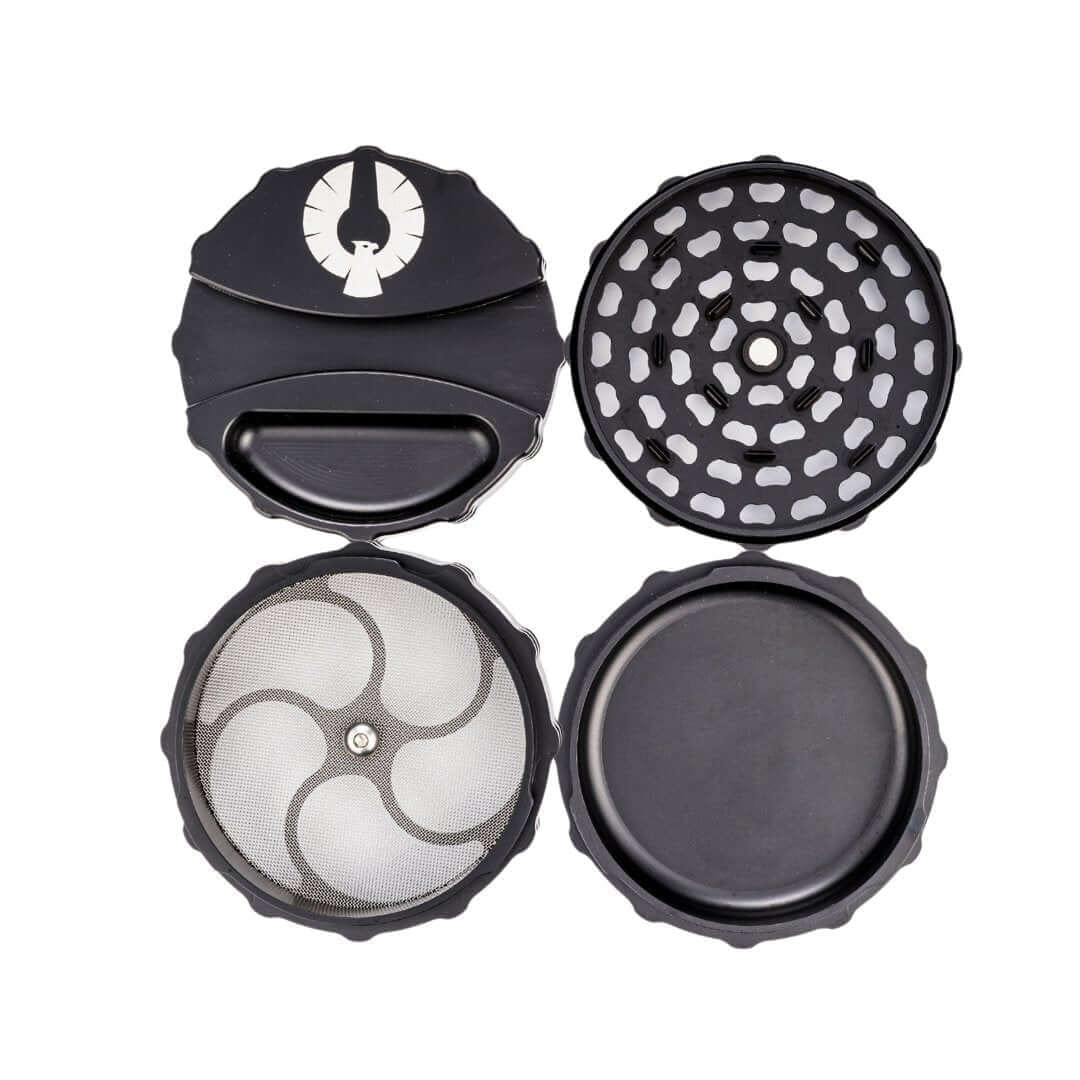
In a 4 piece grinder, ground flower drops out of the teeth and lands on a stainless mesh screen. Every time you twist or tap the grinder, the flower gets jostled, and loose trichomes (the tiny resin glands that frost your buds) shake off and fall through the mesh into the bottom chamber. That golden dust is kief.
The screen has one job: let trichomes through, keep plant matter out. How well it does that depends almost entirely on the size of the holes.
Screen sizes get described two ways, and the internet mixes them up constantly.
So "a fine 80 mesh screen" and "a fine 180 micron screen" are basically the same thing. If a guide tells you a high-micron screen is fine, they've got their units crossed. Here's how the Phoenician screens line up:
| Phoenician screen | Opening | Approx. mesh | Best for |
|---|---|---|---|
| Fine | 180 micron | ~80 mesh | Dry flower, dry climates, cleanest kief |
| Standard (ships installed) | 300 micron | ~50 mesh | Average flower and average humidity |
| Coarse | 400 micron | ~40 mesh | Sticky flower, humid climates, fastest kief |
Fun fact that most grinder brands won't tell you: the resin heads on cannabis trichomes are smaller than all three of these openings. Researchers generally put the big capitate-stalked trichomes at around 200 to 300 microns tall including the stalk, with the resin-filled heads themselves much smaller. So the screen isn't really deciding whether trichomes get through. It's deciding how much leafy junk comes along with them, and how fast resin bridges the holes. Deep dive in our trichomes explainer.

| Your situation | Screen | Why |
|---|---|---|
| Humid climate (Gulf Coast, Southeast, tropical summers) | Coarse 400 | Moist flower is sticky and bridges small holes fast |
| Fresh, frosty top-shelf indoor | Coarse 400 | Heavy resin clogs a fine screen in a week |
| Average dispensary flower, average weather | Standard 300 | Good balance of speed and purity |
| Dry climate (desert, high altitude, heated winter homes) | Fine 180 | Dry flower crumbles, so bigger holes let leaf dust through |
| Older or over-dried flower | Fine 180 | Brittle material breaks into tiny bits that sneak through |
| You want the purest, most golden kief and don't mind waiting | Fine 180 | Less plant matter, slower collection |
| You want the most kief, fast, and don't mind a greener tint | Coarse 400 | Fastest sift, a bit more plant matter |
Our honest advice: if you live somewhere with real seasons, swap screens with the seasons. Coarse in the muggy summer, fine when the heater kicks on and your flower dries out. Same grinder, different job.
Your kief chamber is basically a report card. Read it:
One more thing: a dirty screen behaves like a finer screen than it is, and then like no screen at all. Before you blame the size, clean it. Our grinder cleaning guide covers screen care step by step.
The Phoenician screen sits on a spiral brace and is held by a single center screw, so it's removable instead of glued or pressed in. That's the whole system. Here's the swap:
Total time: about a minute. Two if you dropped the screw.

| Upgrade Kit | Screen Kit | |
|---|---|---|
| Price | $19.99 to $22.99 | $14.99 |
| Screens | 3 (one fine, one standard, one coarse) | 6 (two of each) |
| Extras | Screw, Lexon ring, Allen key, pick, bumper rings | Screw and Allen key |
| Best for | First-time screen swappers, figuring out your favorite | People who already know their size and want spares |
Both come in small, medium and large to match your grinder, so check your size before you order. Already know your size? Grab the Screen Kit for spares. If you also want grip and drop protection on their own, Bumper Rings are $9.99, and everything else lives in grinder accessories.
Totally valid. A 2 piece grinder has no screen, so nothing gets separated and nothing clogs. You get a fluffier grind with all the trichomes still on the flower. The PRO 2 Piece Medium is $39.99. If you want kief, though, you want a 4 piece with a screen you can actually change, like the PRO 4 Piece Medium.
For most people, a standard 300 micron screen. Go coarse (400) for sticky flower or humid weather, fine (180) for dry flower or the purest kief.
Coarser. Microns measure the hole size, so a higher micron number means bigger holes. Mesh count works the opposite way.
Clean it every few weeks with regular use. Replace it if the mesh gets torn, stretched or permanently blinded with resin.
They're sized for Phoenician 4 piece grinders and their screw-and-brace system. We don't recommend them for other brands.
No. A fine screen collects kief more slowly, but trichomes that stay on the flower still end up in your bowl or joint.
The right screen means more kief, cleaner kief and a grinder that doesn't clog. Pick your size, swap it in a minute, and enjoy the report card.

A fact-checked timeline of cannabis history, from ancient hemp and the first evidence of smoking to Reefer Madness, Schedule I, Prop 215 and 2026 rescheduling.

How to read a cannabis COA in two minutes: verify the lab, calculate total THC from THCA, read terpenes and safety panels, and spot inflated results.

All 50 states plus DC in one table: adult-use, medical and home grow status, plus federal Schedule III, the November 2026 ballot and what to watch in 2027.
A 2 piece weed grinder is a lid and a bowl, nothing else. No screen to clog, no chamber to empty, and a fluffier grind because the flower stays in the teeth instead of dropping through holes. Phoenician 2 piece grinders use the same arced cutter blades, threadless quick lock and aircraft grade aluminum as the PRO 4 piece, with a notched grip groove around the body, and they carry the same limited lifetime warranty.
People who roll or pack right away and do not want to collect kief, people who want the fastest clean possible, and anyone who prefers a lighter grinder. If you want to save trichomes, choose a 4 piece grinder with a kief catcher instead.
Medium: 2.47 inch diameter, 1.14 inch tall, 5 oz. The everyday size. $39.99.
Large: 3.225 inch diameter, 1.14 inch tall, 9 oz. For bigger batches and shared sessions. $49.99.
See all weed grinders or read the buyer's guide to compare 2 piece and 4 piece designs side by side.