Your Cart is Empty

Updated October 2026
Short answer: grinding weed increases its surface area so it burns evenly in a joint and heats evenly in a vaporizer. Medium grind is the sweet spot for joints and most dry herb vapes, coarse works for bowls, fine suits conduction vapes and cones. Sharp teeth that cut instead of crush keep more trichomes on the flower, not smeared on the metal.
Science class was never this fun, buddy. No lab coat required, just a lighter and some curiosity. We're a grinder company, so yes, we have strong opinions about this stuff, but we're also going to show you the actual research, because "trust us, bro" isn't science.
Fire and hot air both work on surfaces. A whole nug is a dense little ball: the outside gets scorched while the inside barely warms up. Break that nug into pieces and you've multiplied the surface the flame (or the vape's hot air) can reach. That's the whole game.
Here's what an even grind actually gets you:
This isn't just stoner folklore. In 2023, researchers at DELIC Labs in Vancouver ran joints packed with 1 mm, 3 mm and 5 mm particles through a smoking machine and measured what came out. The highlights:
| Particle size | What happened | Translation |
|---|---|---|
| 1 mm (fine) | Most cannabinoid per puff, burned fastest | Hits hard, but the joint is over quick |
| 3 mm (medium) | Most consistent results between joints | The predictable, every-time-the-same option |
| 5 mm (coarse) | Longest-lasting joints, most total THC delivered over the whole joint | Slow burner, but harder to roll evenly |
The researchers also noted a lot of variability between joints, which tells you something important: grind size matters, but so does how evenly the pieces are cut and packed. A grinder that turns half your bud to powder and leaves the other half in chunks gives you the worst of both worlds.
The same lab separately found that grinding to a smaller particle size improved extraction recovery without degrading cannabinoids or terpenes. Different application (industrial extraction), same principle: surface area is king.

Here's the science bit most grinder companies skip. Trichomes, the tiny resin glands frosting your flower, are fragile. They're basically microscopic mushrooms full of sticky oil. When a grinder mashes bud between blunt pegs, it squishes those heads and smears the resin onto the metal. That's the gunk on your teeth after a month. That gunk was supposed to be in your joint.
When a grinder cuts, the flower gets sliced into pieces and the trichomes mostly stay attached (or fall cleanly into the kief chamber). Less smearing, less buildup, more of the good stuff where it belongs. More on those little resin glands in our trichomes explainer.
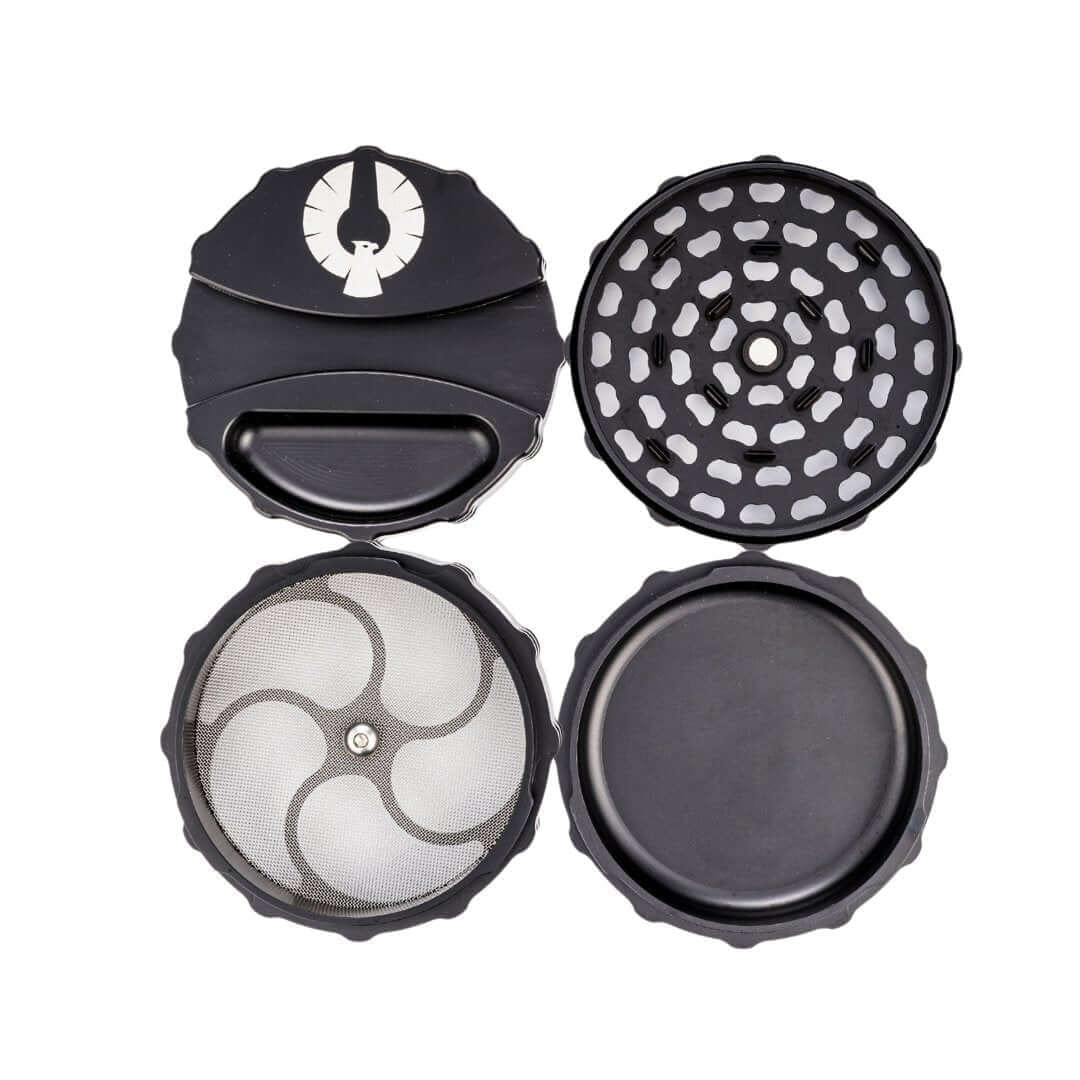
That's why Phoenician grinders use fewer, diametrically cut, razor-sharp teeth that slice like scissors instead of a forest of dull pegs. Pair that with oversized trapezoidal drop-through holes, and ground flower falls out of the teeth as soon as it's cut, instead of getting spun around and pulverized into dust. Fewer rotations, more even pieces.
You can. We've all been there. But each method has a cost:
| Method | Consistency | Trichome loss | Verdict |
|---|---|---|---|
| Fingers | Lumpy, random | High, resin ends up on your skin | Fine in a pinch, sticky forever |
| Scissors in a cup | Better, still uneven | Medium, blades gum up fast | Works, slow, messy |
| Cheap peg grinder | Mix of dust and chunks | Medium to high, smeared on pegs | Better than nothing until it seizes |
| Cutting-tooth 4 piece grinder | Even, adjustable | Low, loose trichomes caught as kief | The right tool for the job |
Rule of thumb: if your fingers smell like the strain for an hour after rolling, that smell is trichome oil that didn't make it into your session.
Different heat sources want different textures. Here's the cheat sheet:
| Method | Ideal grind | Why |
|---|---|---|
| Hand-rolled joints | Medium, fluffy | Even burn, rolls tight without packing into a brick |
| Pre-rolled cones | Medium to fine | Packs down the narrow tip without air pockets |
| Blunts | Medium | Thicker wrap tolerates slightly bigger pieces |
| Bowls and bongs | Coarse to medium | Bigger pieces won't get sucked through the bowl |
| Convection vapes | Medium | Hot air needs room to pass through the chamber |
| Conduction vapes | Fine | More flower touching the hot chamber walls |
| Edibles and infusions | Coarse | Fine powder ends up in your butter and tastes grassy |
For edibles specifically, our guide to grinding weed for edibles and infusions goes deeper.
One grinder, three textures. Here's the method:
Want to see the difference? Our coarse vs fine grind video shows it side by side, and the Grind Guide covers technique for every setup.

A 4 piece grinder has a stainless screen that sifts loose trichomes into the bottom chamber as kief. Some people love that stash for a special-occasion sprinkle. Others feel like the grinder is "stealing" from every bowl.
Both camps are right, and you get to choose:
Dry herb vapes heat flower below the point of combustion, so they don't burn it, they warm it until the active compounds and terpenes vaporize. That process is all surface area. Chunks heat on the outside only; dust clogs the screen and blocks airflow. A consistent medium grind gives convection vapes the best mix of airflow and contact, and a little finer helps conduction-style vapes where the flower heats against the chamber walls.
Pro tip: don't pack a vape chamber like a bong bowl. Fill it, tap it down lightly, and let the air move.
Not in the sense of adding THC. Grinding makes the flower burn or vaporize more efficiently, so less of it gets wasted as charred edges or unheated chunks. In the DELIC Labs study, finer grinds delivered more per puff while coarser grinds lasted longer.
Medium is the safest bet. Fine burns fast and can pack too tight; coarse lasts longer but is harder to roll evenly. Medium was also the most consistent in testing.
Blunt grinders smear some of them onto the teeth. Sharp cutting teeth leave most of them on the flower, and a 4 piece catches the ones that fall loose as kief.
Ground flower loses aroma faster than whole buds because more surface is exposed to air. Grind right before your session instead of grinding a week's worth in advance.
That's the science. Even pieces, sharp teeth, right size for the method. Your flower already did the hard part by growing; the least you can do is cut it properly.

A fact-checked timeline of cannabis history, from ancient hemp and the first evidence of smoking to Reefer Madness, Schedule I, Prop 215 and 2026 rescheduling.

How to read a cannabis COA in two minutes: verify the lab, calculate total THC from THCA, read terpenes and safety panels, and spot inflated results.

All 50 states plus DC in one table: adult-use, medical and home grow status, plus federal Schedule III, the November 2026 ballot and what to watch in 2027.
A 2 piece weed grinder is a lid and a bowl, nothing else. No screen to clog, no chamber to empty, and a fluffier grind because the flower stays in the teeth instead of dropping through holes. Phoenician 2 piece grinders use the same arced cutter blades, threadless quick lock and aircraft grade aluminum as the PRO 4 piece, with a notched grip groove around the body, and they carry the same limited lifetime warranty.
People who roll or pack right away and do not want to collect kief, people who want the fastest clean possible, and anyone who prefers a lighter grinder. If you want to save trichomes, choose a 4 piece grinder with a kief catcher instead.
Medium: 2.47 inch diameter, 1.14 inch tall, 5 oz. The everyday size. $39.99.
Large: 3.225 inch diameter, 1.14 inch tall, 9 oz. For bigger batches and shared sessions. $49.99.
See all weed grinders or read the buyer's guide to compare 2 piece and 4 piece designs side by side.