Your Cart is Empty

Updated October 2026
Short answer: as of October 2026, adult-use (recreational) cannabis is legal in 24 states plus Washington, DC. Forty-one states plus DC have comprehensive medical programs, eight more allow only low-THC or CBD products, and Idaho allows neither. Federally, adult-use marijuana is still Schedule I. Only state-licensed medical and FDA-approved marijuana moved to Schedule III in April 2026.
Every few months someone at a trade show asks us, "Wait, is it legal in [state] now?" Fair question. The map has changed more since 2012 than our product line has, and that's saying something.
So we built the table we wanted: all 50 states plus DC, adult-use status and year, medical status, home grow and the stuff that actually trips people up. Then the federal picture, what changed in 2025 and 2026, what's on the ballot November 3, and what to watch in 2027. We're a grinder company, not a law firm. Every row is sourced, and anything we couldn't pin down is flagged.
Adult-use year = the year voters or lawmakers approved it (sales often started later). Medical "Yes" = a comprehensive program per NCSL. Home grow comes from state law summaries compiled in 2026; plant limits vary and many states require plants to be locked and out of public view.
| State | Adult-use | Medical | Home grow | Notes |
|---|---|---|---|---|
| Alabama | No | Yes | No | First medical dispensary opened June 2026. No smokable flower. |
| Alaska | Yes (2014) | Yes | Yes | Up to 6 plants per adult, 12 per home. |
| Arizona | Yes (2020) | Yes | Yes | Prop 207. No public consumption. |
| Arkansas | No | Yes | No | |
| California | Yes (2016) | Yes | Yes | 6 plants per residence. Cities can ban stores. |
| Colorado | Yes (2012) | Yes | Yes | One of the first two adult-use states. Licensed hospitality spaces exist where approved locally. |
| Connecticut | Yes (2021) | Yes | Yes | Indoor only. |
| Delaware | Yes (2023) | Yes | No | Legal to buy, not to grow. |
| District of Columbia | Yes (2014) | Yes | Yes | Possession and home grow legal, but no licensed adult-use sales. |
| Florida | No | Yes | No | 2026 legalization initiative didn't make the ballot. |
| Georgia | No | Yes | No | SB 220 (effective July 1, 2026) replaced the low-THC oil program. Vaping allowed, smoking flower not. |
| Hawaii | No | Yes | Patients only | Registered patients and caregivers. |
| Idaho | No | No | No | HJR 4 on the November 2026 ballot (see below). |
| Illinois | Yes (2019) | Yes | Patients only | Medical patients may grow up to 5 plants. |
| Indiana | No | Low-THC only | No | |
| Iowa | No | Low-THC only | No | |
| Kansas | No | Low-THC only | No | Listed as low-THC/CBD by NCSL. |
| Kentucky | No | Yes | No | Medical program created by 2023 law. |
| Louisiana | No | Yes | No | |
| Maine | Yes (2016) | Yes | Yes | A repeal campaign missed 2026 and is aiming for 2027. |
| Maryland | Yes (2022) | Yes | Yes | 2 plants per household. |
| Massachusetts | Yes (2016) | Yes | Yes | Question 8 on the November 3 ballot would end adult-use sales and home grow. |
| Michigan | Yes (2018) | Yes | Yes | 12 plants per residence. |
| Minnesota | Yes (2023) | Yes | Yes | 8 plants, no more than 4 flowering. |
| Mississippi | No | Yes | No | |
| Missouri | Yes (2022) | Yes | Yes | Requires a state cultivation registration. |
| Montana | Yes (2020) | Yes | Yes | 2 mature plants per adult. |
| Nebraska | No | Yes* | No | *Voters approved medical in 2024, but no legal sales yet. Regulators' timeline is sliding into 2027. |
| Nevada | Yes (2016) | Yes | Limited | Generally only if you live 25+ miles from a dispensary. |
| New Hampshire | No | Yes | No | The only New England state without adult-use. |
| New Jersey | Yes (2020) | Yes | No | Legal to buy, not to grow. |
| New Mexico | Yes (2021) | Yes | Yes | 6 mature plants per adult. |
| New York | Yes (2021) | Yes | Yes | 3 mature plants per adult, 6 per household. |
| North Carolina | No | Low-THC only | No | |
| North Dakota | No | Yes | No | |
| Ohio | Yes (2023) | Yes | Yes | SB 56 (signed Dec 2025) moved intoxicating hemp into dispensaries and capped stores at 400. |
| Oklahoma | No | Yes | Patients only | Licensed patients only. |
| Oregon | Yes (2014) | Yes | Yes | 4 plants per residence. No public consumption. |
| Pennsylvania | No | Yes | No | 2026 legalization bills died. |
| Rhode Island | Yes (2022) | Yes | Yes | 3 mature plants per dwelling. |
| South Carolina | No | Low-THC only | No | |
| South Dakota | No | Yes | Patients only | Authorized patients only. |
| Tennessee | No | Low-THC only | No | |
| Texas | No | Yes* | No | *Compassionate Use Program: no smoking and no raw flower. Expanded by HB 46 in 2025. |
| Utah | No | Yes | No | |
| Vermont | Yes (2018) | Yes | Yes | Legalized by lawmakers, not voters. |
| Virginia | Yes (2021) | Yes | Yes | 4 plants per household. Licensed retail sales start July 1, 2027. |
| Washington | Yes (2012) | Yes | Patients only | Adults can buy, but only registered patients can grow. |
| West Virginia | No | Yes | No | |
| Wisconsin | No | Low-THC only | No | |
| Wyoming | No | Low-THC only | No |
Sources: NCSL medical and adult-use lists (Sept 2026); Marijuana Policy Project state counts; home grow summaries compiled by The Marijuana Herald (2026); state notes from the sources linked in the sections below. Local rules can be stricter than state law, and decriminalization in non-legal states isn't shown.
Federal law is a two-tier mess right now.
We go deeper on all of it, including what it means for smoke shops, in our DEA Schedule III update. Confused about hemp vs marijuana in the first place? Start with CBD vs THC.
This year's ballot is mostly about rolling things back, not moving forward. Per NORML's election tracker:
Didn't qualify: Florida's adult-use amendment, Idaho's medical cannabis initiative, an Arizona measure to roll back commercial sales, Ohio's SB 56 referendum and Maine's repeal effort, which is targeting 2027.
Planning a trip? Our cannabis travel guide covers where tourists can buy, where you can actually consume and what to pack. Thinking about growing? Start with our home grow guide and check the table above first.
Here's the question we get from customers in non-legal states. Grinders are sold online and in shops across the country, but they live in a gray zone. The federal paraphernalia statute, 21 U.S.C. 863, covers equipment primarily intended for use with illegal controlled substances, and it exempts items traditionally intended for use with tobacco and people authorized by state or local law. States layer their own paraphernalia laws on top.
In practice, a clean grinder is a legal purchase in most places. A grinder full of weed in a state where weed is illegal is a different conversation. Our rescheduling post breaks down the paraphernalia law, and if you run a shop, ask a lawyer who knows your state.
Whatever your state's status, legal flower still shows up dense and sticky. A grinder that cuts instead of crushes gets you an even burn and keeps the kief. Our grind guide covers how fine to go for joints, bowls and vapes.


Twenty-four states plus Washington, DC allow adult-use cannabis as of October 2026. Forty-one states plus DC have comprehensive medical programs.
No. Since April 28, 2026, state-licensed medical marijuana and FDA-approved marijuana drugs are Schedule III. Adult-use marijuana is still Schedule I, and the broader DEA rescheduling proceeding is paused.
No new legalization measure is on the November 2026 statewide ballot. Virginia's retail sales start July 1, 2027. Pennsylvania and New Hampshire had bills die in 2026, so watch their next sessions.
No. Crossing state lines with cannabis is a federal offense, even between two legal states. Buy it where you are and finish it there.
Delaware and New Jersey ban it. Illinois and Washington allow it only for registered medical patients, and Nevada generally only if you live far from a dispensary.
The map will change again. Your grinder doesn't need to. Get one that outlasts the next few election cycles.

A fact-checked timeline of cannabis history, from ancient hemp and the first evidence of smoking to Reefer Madness, Schedule I, Prop 215 and 2026 rescheduling.

How to read a cannabis COA in two minutes: verify the lab, calculate total THC from THCA, read terpenes and safety panels, and spot inflated results.

The plain-English difference between CBD and THC: the chemistry, how each feels, THCA and delta-8, the late-2026 federal hemp changes, drug tests and how to read a label.
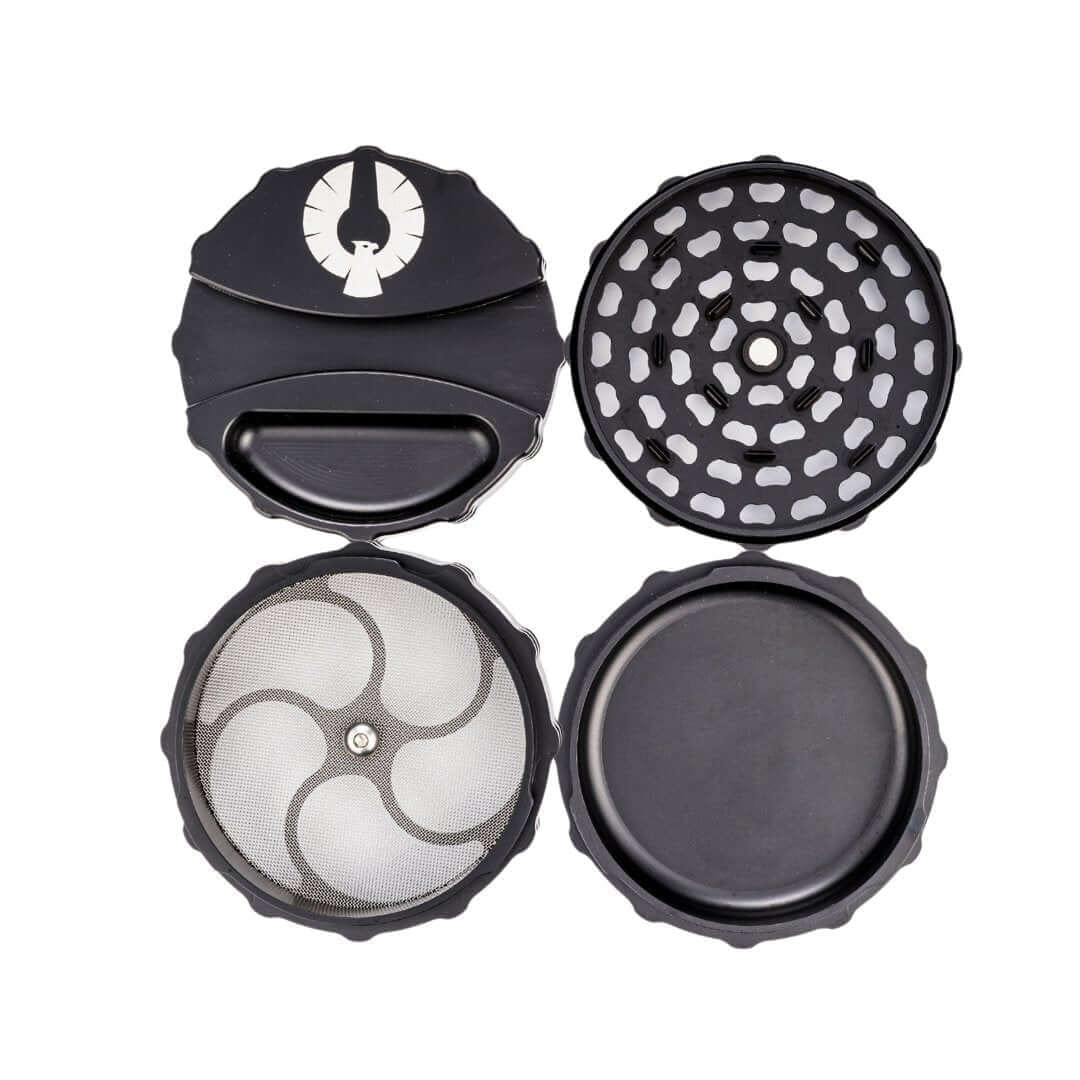
A 2 piece weed grinder is a lid and a bowl, nothing else. No screen to clog, no chamber to empty, and a fluffier grind because the flower stays in the teeth instead of dropping through holes. Phoenician 2 piece grinders use the same arced cutter blades, threadless quick lock and aircraft grade aluminum as the PRO 4 piece, with a notched grip groove around the body, and they carry the same limited lifetime warranty.
People who roll or pack right away and do not want to collect kief, people who want the fastest clean possible, and anyone who prefers a lighter grinder. If you want to save trichomes, choose a 4 piece grinder with a kief catcher instead.
Medium: 2.47 inch diameter, 1.14 inch tall, 5 oz. The everyday size. $39.99.
Large: 3.225 inch diameter, 1.14 inch tall, 9 oz. For bigger batches and shared sessions. $49.99.
See all weed grinders or read the buyer's guide to compare 2 piece and 4 piece designs side by side.