Your Cart is Empty

Updated October 2026
Short answer: the classic strains every modern menu still owes something to are OG Kush, Sour Diesel, Chemdawg, Northern Lights, White Widow, AK-47, Super Silver Haze, Super Skunk, Bubba Kush, Granddaddy Purple, Purple Haze, Headband and the old-school Thai stick. Here's where each came from, what it's like, and how to grind it.
Half the strains on a 2026 dispensary menu are grandkids of the ones on this page. Kush Mints, Wedding Cake, every "OG" with a number after it: all of them trace back to a short list of plants that got passed around at concerts, smuggled home in duffel bags, or entered in Amsterdam cannabis cups in the '90s. These are the legends. We dug into the real histories (including the ones nobody agrees on) and, because we're a grinder company, we added the part nobody else writes: how to actually grind each one.
For adults 21+ where cannabis is legal. Rules vary by state, so check your local law.
Nobody knows for sure, and anyone who tells you otherwise is guessing loudly. The two popular theories:
What is documented: Leafly's OG Kush history places the strain in Florida in the early 1990s, with the cut arriving in Los Angeles around 1996. From there "OG" turned into a badge of honor, and now it's on more strain names than anyone can count. Today we use "OG strains" loosely to mean the classics: the foundational plants modern breeding is built on.
| Strain | Era / origin | Dominant aroma | Density / stickiness | Recommended screen |
|---|---|---|---|---|
| OG Kush | Early '90s, Florida to L.A. | Fuel, pine, lemon | Dense, sticky | 400 coarse |
| Chemdawg | 1991, Grateful Dead bag seed | Diesel, chemical | Big calyxes, very resinous | 400 coarse |
| Sour Diesel | Early '90s, East Coast | Diesel, citrus | Medium-dense, sticky | 300 standard |
| Northern Lights | '70s-'80s, Pacific Northwest | Sweet spice, pine | Tight, dense, resinous | 400 coarse |
| White Widow | 1990s, Netherlands | Woody, earthy, floral | Frosty, lighter buds | 300 standard |
| AK-47 | 1992, Netherlands | Sour, earthy, skunk | Medium, heavy frost | 300 standard |
| Super Silver Haze | 1990s, Netherlands | Citrus peel, incense | Airier, sticky | 300 standard |
| Super Skunk | Skunk era, Netherlands | Skunk, earth, licorice | Dense, resinous | 400 coarse |
| Bubba Kush | Mid-'90s, U.S. | Hash, coffee, chocolate | Bulky, dense | 400 coarse |
| Granddaddy Purple | 2003, California | Grape, berry | Dense, frosty | 400 coarse |
| Purple Haze | Named for the 1967 song | Berry, spice, floral | Airy, light | 180 fine |
| Headband | OG Kush x Sour Diesel | Lemon, diesel, cream | Dense, sticky | 400 coarse |
| Thai stick | '60s-'70s, Thailand | Earthy, spicy, sweet | Compressed, often coated | No screen (2 piece) |
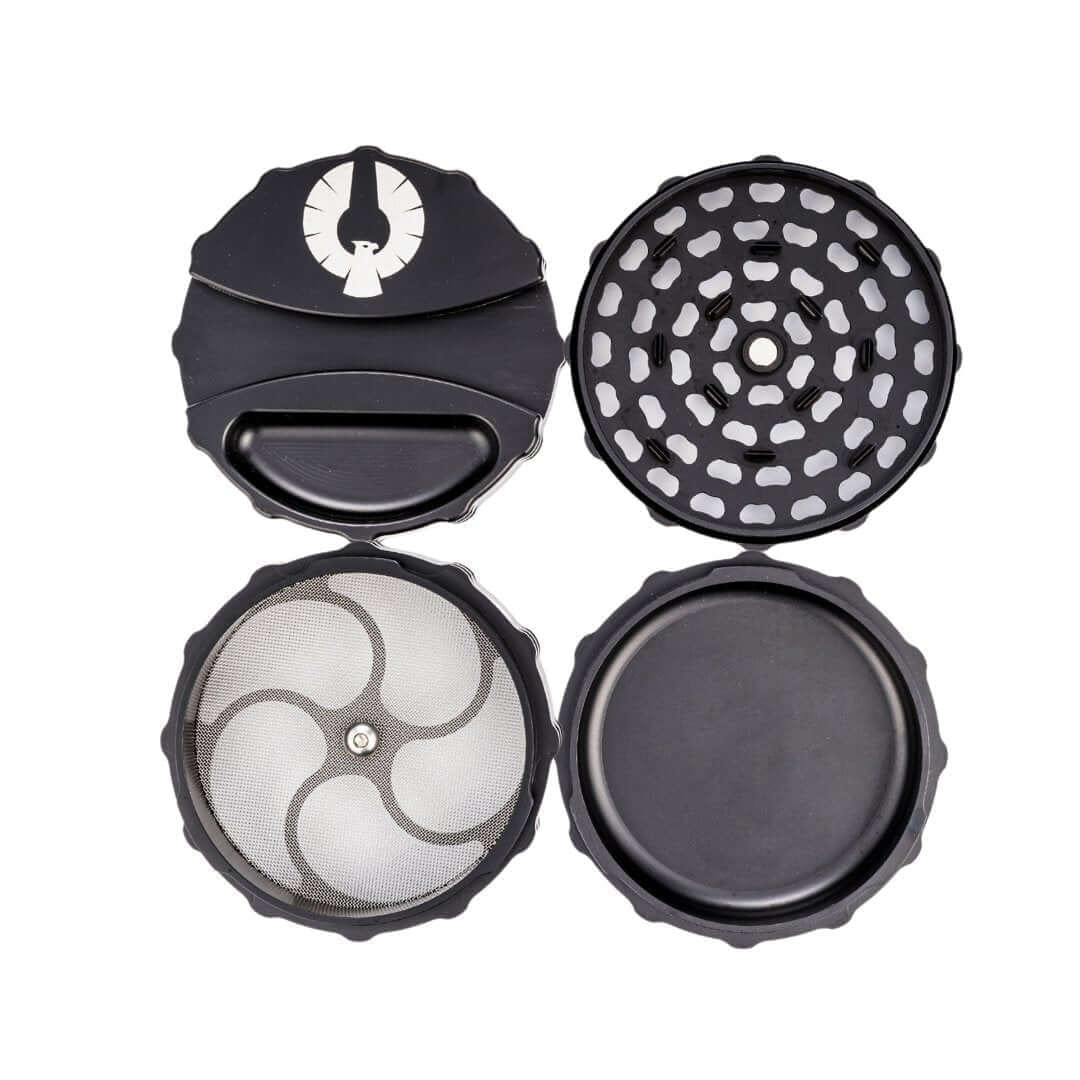
Quick reminder on the screen column: on a 4 piece, the screen decides what falls into your kief chamber, while the number of turns decides how fine the flower is. Sticky flower wants the 400 coarse screen so resin can't clog the mesh. Light, dry flower wants the 180 fine screen for cleaner kief. All three come in the Upgrade Kit.
The West Coast's foundation stone. Florida in the early '90s, L.A. by 1996, and then everywhere. Its exact parents are still argued about; Chemdawg, Lemon Thai and Hindu Kush are the usual suspects. The aroma is fuel, skunk and spice with pine and lemon, and people often describe the high as heavy and relaxing.
How to grind it: Dense, sticky buds. 4 piece with the 400 coarse screen, pea-size pieces, 4 to 5 short turns. Joint or bowl. Full story in our OG Kush strain guide.
The origin story is pure folklore with a paper trail: seeds found in what was thought to be Northern California bag weed at a Grateful Dead show in Colorado, grown out by a breeder known as Chemdog from 1991. It's widely credited as an ancestor of both OG Kush and Sour Diesel. Sharp diesel and chemical smell, the kind you notice from across a parking lot.
How to grind it: Big calyxes and rivers of trichomes. Coarse 400 screen, short turns, tap it out. Read more in our Chemdawg 91 deep dive.
East Coast royalty from the early '90s. Leafly lists it as Chemdawg x Super Skunk, though the full story (and which Chem cut was involved) is disputed among old-school growers. Pungent diesel with citrus; people often describe it as fast, energizing and cerebral, the classic daytime strain.
How to grind it: Medium-dense, sativa-leaning buds. Standard 300 screen, 3 to 4 turns. Perfect joint flower. See the Sour Diesel strain guide.
Afghani x Thai, likely born in the Pacific Northwest near Seattle and made famous in Holland after 1985 through Sensi Seeds. It's a parent of Super Silver Haze and Shiva Skunk. Sweet and spicy with pine; people often describe it as deeply relaxing, an end-of-night strain.
How to grind it: Tight, dense, resin-coated buds. 400 coarse screen and a few extra turns if you're loading a bowl. The Northern Lights strain guide has the rest.

The '90s Amsterdam icon. Bred by Shantibaba while at Green House Seeds from a Brazilian sativa and a South Indian indica, and it won the Cannabis Cup in 1995, according to its Wikipedia entry. The name comes from the white blanket of resin. Woody, earthy and floral; people often report an energetic, talkative buzz.
How to grind it: Frosty but lighter buds. Standard 300 screen; go fine in dry climates. Expect a lot of kief. More in our White Widow guide.
Released by Serious Seeds in 1992, blending Colombian, Mexican, Thai and Afghani genetics. Per its Wikipedia page, it had racked up sixteen awards by 2020, including wins as both a "sativa" and an "indica," which is very on-brand for a strain whose name sounds aggressive and whose effects people describe as mellow. Sour, earthy and skunky.
How to grind it: Medium density, heavy frost. Standard 300 screen, 3 to 4 turns, joint. Full profile: AK-47 strain guide.
Green House Seeds crossed Skunk, Northern Lights and Haze and won the High Times Cannabis Cup three years running: 1997, 1998 and 1999. Bright citrus peel, herbal middle, incense on the exhale. People often describe it as uplifting and long-lasting.
How to grind it: Sticky but airier sativa structure. Standard 300 screen, only 2 to 3 turns so you don't dust it. Read the Super Silver Haze guide.
Skunk #1 x Afghani, a longtime Sensi Seeds catalog staple. Leafly lists it in Sour Diesel's family tree. It smells exactly like the name: skunk, earth, a weird hint of black licorice. People often describe it as a full-body relaxer.
How to grind it: Dense and resinous. 400 coarse screen, 4 short turns, bowl. Details in the Super Skunk strain guide.
Around 1996, an OG Kush plant pollinated an unknown indica that came from New Orleans, at least according to the most-told version of the story. Its genetics aren't certain, but its descendants are: Kush Mints and Wedding Cake both trace back here. Sweet hash, coffee and chocolate. People often save it for the end of the night.
How to grind it: Bulky, dense buds. Hand-break first, 400 coarse screen, short turns, bowl. More in our Bubba Kush strain guide.
Popularized in California in 2003 by Ken Estes. The commonly cited cross is Purple Urkle x Big Bud, though some sources list a Mendo Purps, Skunk and Afghani background instead. Deep purple buds, grape and berry nose, and people often describe it as relaxing without being a total knockout.
How to grind it: Dense and frosty. 400 coarse screen, 4 turns, bowl or joint. Full profile: Granddaddy Purple guide.
Named for (and popularized by) Jimi Hendrix's 1967 song. The commonly listed lineage is Purple Thai x Haze, and how far back the actual plant goes is murky. Sweet berry, earth and sharp spice; people often describe it as creative and energizing.
How to grind it: Airy, light sativa buds. Easy does it: 2 turns, 180 fine screen for clean kief, or a 2 piece for a fluffy joint grind. Read the Purple Haze guide.
OG Kush x Sour Diesel, two legends in one plant. The name comes from the pressure people describe feeling around the crown of the head, like wearing a headband. Lemon and diesel with a creamy smoke; it's a parent of Paris OG and Pink Starburst.
How to grind it: Dense and sticky like both parents. 400 coarse screen, short turns, joint. The Headband strain guide has more.
Less a strain than a legend. Thai landrace buds were tied around a bamboo stick, wrapped in fan leaves and bound with hemp string, a tradition from northeast Thailand. They reached the U.S. in the 1960s and '70s with surfers and Vietnam veterans, and the supply mostly dried up in the 1980s. Modern versions are often coated with concentrate or kief.
How to grind it: Pull the stick and string first (please don't grind bamboo). Break it up by hand; concentrate-coated pieces will gum a screen, so use a PRO 2 Piece Medium with short turns. Full story: the legendary Thai stick.
Well-grown classics like OG Kush, Bubba Kush and Headband are dense and sticky. That's where sharp, diametrically cut teeth (fewer of them, and they actually cut), oversized trapezoidal drop-through holes and a threadless lock come in. Nothing to cross-thread, nothing for resin to seize. A short twist, about a third of a turn, locks it shut or opens it up.

Want what's hot right now instead of what's legendary? Our best weed strains of 2026–2027 gets the same treatment for Glitter Bomb, Zoap, Hash Burger and more.
OG Kush is the usual answer, since so many modern strains descend from it. White Widow, Northern Lights and Sour Diesel are right there too.
Nobody knows for sure. "Ocean Grown" and "Original Gangster" are the two main theories. Today it usually just means a classic or a descendant of OG Kush.
Many newer strains are bred for higher THC, but numbers vary a lot by grower and batch. A well-grown classic still holds its own.
Break buds to pea size, load the grinder loosely, use a 400 micron coarse screen and short back-and-forth turns. If resin builds up, a few minutes in the freezer makes it easy to tap out.
The classics earned their spot. Give them a grinder that does them justice.

A fact-checked timeline of cannabis history, from ancient hemp and the first evidence of smoking to Reefer Madness, Schedule I, Prop 215 and 2026 rescheduling.

How to read a cannabis COA in two minutes: verify the lab, calculate total THC from THCA, read terpenes and safety panels, and spot inflated results.

All 50 states plus DC in one table: adult-use, medical and home grow status, plus federal Schedule III, the November 2026 ballot and what to watch in 2027.
A 2 piece weed grinder is a lid and a bowl, nothing else. No screen to clog, no chamber to empty, and a fluffier grind because the flower stays in the teeth instead of dropping through holes. Phoenician 2 piece grinders use the same arced cutter blades, threadless quick lock and aircraft grade aluminum as the PRO 4 piece, with a notched grip groove around the body, and they carry the same limited lifetime warranty.
People who roll or pack right away and do not want to collect kief, people who want the fastest clean possible, and anyone who prefers a lighter grinder. If you want to save trichomes, choose a 4 piece grinder with a kief catcher instead.
Medium: 2.47 inch diameter, 1.14 inch tall, 5 oz. The everyday size. $39.99.
Large: 3.225 inch diameter, 1.14 inch tall, 9 oz. For bigger batches and shared sessions. $49.99.
See all weed grinders or read the buyer's guide to compare 2 piece and 4 piece designs side by side.